Problem
Research, drafting, implementation ideas, and operating notes lived in separate conversations, which left me reconstructing ownership and next actions from memory.
Operating System Case Study
A local AI team built to make real work easier to see, review, and move forward—without handing off the judgment that should stay human.
I built this because useful AI work was getting lost across chats, tabs, and half-finished handoffs. The goal was simple: give research, editorial work, technical checks, social drafts, and workflow reporting a visible home while keeping the final call with a person.
Working local system Evidence reviewed September 15, 2026 ROI not independently measured
Evidence Snapshot
Working Evidence
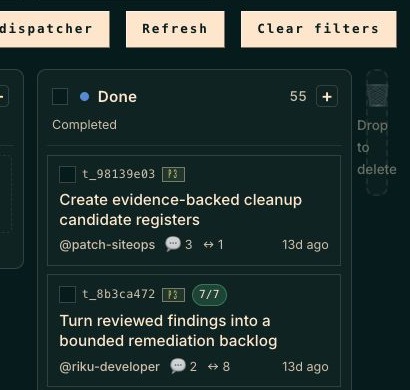
The useful part is not a chat transcript. It is the record around the work: who handled it, what child tasks were completed, what comments remain, and how long ago the result landed.
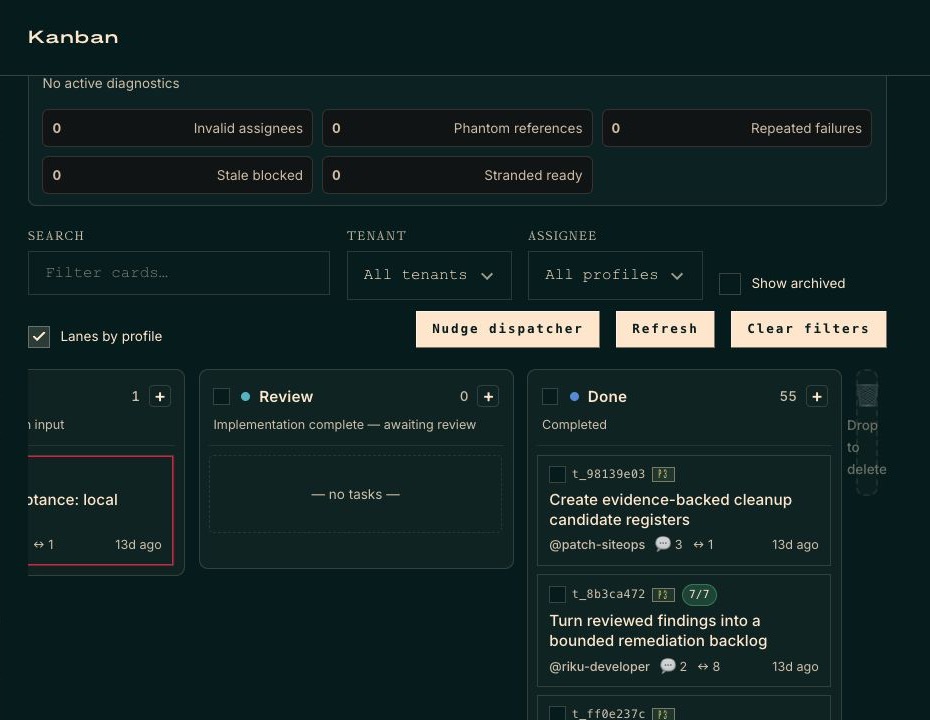
Business Snapshot
Research, drafting, implementation ideas, and operating notes lived in separate conversations, which left me reconstructing ownership and next actions from memory.
Give each kind of work a clear lane, put the request and result where I can inspect them, and keep meaningful actions behind an explicit approval step.
Used the system for terminal-only workflow reporting, social-reply preparation, and a documented local site-cleanup and recovery-prep cycle.
A reusable pattern for teams that want AI help to be visible, reviewable, and maintainable instead of quietly over-authorized.
Design Principle
This system is designed to make that easy to see. It can prepare, organize, route, and report work. A polished response, session count, or successful request still is not enough to justify a public or hard-to-reverse action.
Research, editorial QA, technical work, site checks, social preparation, and creative direction each have their own lane and a clear stopping point.
Requests, task state, results, and limitations can be reviewed instead of being inferred from a trail of browser tabs and chat windows.
Publishing, external messages, deployment, credentials, spending, deletion, and final approvals stay with me.
ROI Snapshot
I estimate 2–4 hours reclaimed per week during active content and operations work. That is a conservative coordination model, not a revenue claim or a promise that the system runs unattended.
A conservative model based on fewer context-reconstruction loops across recurring research, editorial, reporting, and technical-prep handoffs.
Visible board context, named work lanes, and review-ready outputs reduce the time spent finding the right chat, rebuilding status, and explaining the same constraint again.
Track verified work cycles, task-to-review duration, rework, and time spent reconstructing status. That will turn this model into a measured operating baseline.
1. The Problem
Research questions, drafts, coding ideas, site notes, social replies, and workflow documentation lived in separate chats and tabs. That was useful for experimentation, but it made ownership and work history hard to reconstruct.
The issue was not a shortage of capable models. I needed a simpler way to see what had been checked, what was blocked, and what needed a human decision.
2. Constraints and Principles
The coordination layer, supporting data, and execution environment remain close to the operator. That makes boundaries easier to inspect and failures easier to investigate.
A response, receipt, or URL does not by itself prove the resulting artifact is correct. Important work needs a reviewable output, a status, and an explicit statement of what was verified.
Giving each kind of work a name and a boundary makes handoffs easier to understand and prevents research, drafting, implementation, and publishing from quietly blending together.
The system can prepare work and make the next decision clearer. A person decides when work becomes public, expensive, destructive, or difficult to reverse.
3. The System Design
Hina is the coordinator. She keeps the bigger objective in view, routes focused work, and makes the next decision easier to see. She is not here to run the business for me.
Mina handles editorial architecture and QA. Mori handles research, source confidence, SEO reasoning, overlap checks, and link recommendations.
Riku works on development and technical implementation. Patch performs read-only site and operational checks, keeping inspection separate from the authority to change a live system.
Kiko prepares social adaptations without publishing or engaging. Sora handles creative direction and visual planning; generated output does not replace evidence or approval.
These are work lanes, not an autonomous hierarchy. That keeps a research task from quietly turning into a publishing task, or a code suggestion from turning into a deployment.
4. How the Build Fits Together
This is a local stack of small tools with clear jobs. Keeping them separate makes the system easier to repair and less likely to quietly overreach.
Obsidian holds the durable notes, operating rules, role guides, workflow SOPs, and project context. It is the human-readable knowledge base the rest of the system can refer back to.
The dashboard is a separate local application built to make the family’s work, approvals, and next decisions visible. It is where I can see the status of the system without turning a dashboard into a decision-maker.
The task runner is also separate. It starts and tracks focused work, while Hermes provides the agent harness behind the family profiles. That keeps the interface, orchestration, and agent runtime from becoming one tangled system.
n8n handles the repeatable jobs: the workflows that call approved services, collect information, and return a result. A terminal-only runner can start an approved workflow by name or ID without taking over a browser session.
A request starts with a clear goal and enough context from the second brain to make the work understandable: implementation, research, review, audit, planning, or a blocked investigation.
The dashboard and runner pass the focused request to the right profile through Hermes. The role boundaries matter: a social draft is not a post, a site check is not a deployment, and a report run is not a credential change.
The useful output is a working change, a verified decision, or a blocked result with evidence. I review anything that becomes public, costly, destructive, or difficult to reverse.
Illustrative Workflow
Hina routes the request to the reporting lane. The approved terminal-only runner starts the named n8n workflow, which reads permitted services and returns a metrics receipt. The receipt records what was fetched, what failed, and what remains unknown. Michael decides whether any follow-up, change, or outward action happens next.
That report can be prepared without taking over a browser session or granting the runner authority to publish, change credentials, or make the business decision. Runtime V2 provenance work remains future architecture, not a claimed live capability.
5. Evidence Interpretation
Verified on September 15, 2026: the dashboard held seven profiles, 654 sessions, 56,783 messages, and eight connected sources. That is operating history, not a productivity claim: sessions include exploration, repeats, and work that still needs checking.
The more useful proof is the kind of work it has supported: terminal-only n8n reporting, social-reply preparation, and local site-cleanup preparation, with outward action remaining human-controlled.
6. Technical Proof Point
The clearest proof point came from a September 4 site-cleanup handoff involving GetPrompting and MichaelStables. The work refreshed local development mirrors from live production, imported local databases, rewrote local URLs, and checked both local sites over HTTP. Both returned 200 OK.
The handoff also separated deployable source from runtime drift. For MichaelStables, the full WordPress runtime mirror was no longer treated as a deploy repository; deployable custom code was given its own source boundary. That is an unglamorous distinction, but it lowers the risk of treating a messy runtime copy as authoritative code.
Emergency redeploy tooling was created and dry-run. Bundle building, provider provisioning, restore handling, and wrapper behavior were tested without performing a provider restore.
No production deployment occurred in that cleanup scope. No live database changed and no new provider host was provisioned. The deployment gate stayed in place.
That is the kind of result I want from AI-assisted work: a documented working slice, the checks that passed, and a clear record of the action I chose not to take.
7. What Stays Human-Controlled
The AI team can draft, report, propose, and prepare. It cannot decide that review is unnecessary, turn a dry run into production action, or mark something published because a request returned successfully.
8. Limits and Next Steps
Dashboard signals can be stale, session history does not prove an outcome, and a task receipt does not guarantee that the resulting artifact is correct. Reporting and documentation still need to become more consistent.
Next: connect an objective to a bounded request, record the result, check it independently, and document what remains for specialist or owner review. The goal is measured outcomes, not more activity.
9. What I’d Do Differently
I would specify the evidence and completion receipt before adding another role or tool connection.
I would make it harder to miss when a dashboard signal is old, incomplete, or unavailable.
I would separate completed, independently checked workflow outcomes from session activity and task volume.
Start with a $49 Workflow Review: a focused async review, a written fix path, and a practical workflow map before you invest in a larger build.